
Fishing Calendar for Today
Many anglers plan trips around solunar times — the periods when the Moon is overhead or underfoot (major periods) and when it rises or sets (minor periods) — together with dawn and dusk. Enter your location and date to see today’s solunar periods, moon phase, sunrise and sunset, a simple day rating and the week ahead, all calculated from astronomical positions of the Sun and Moon.
- Instant download
- Editable Excel & Word
- Print-ready PDF
- 7-day refund
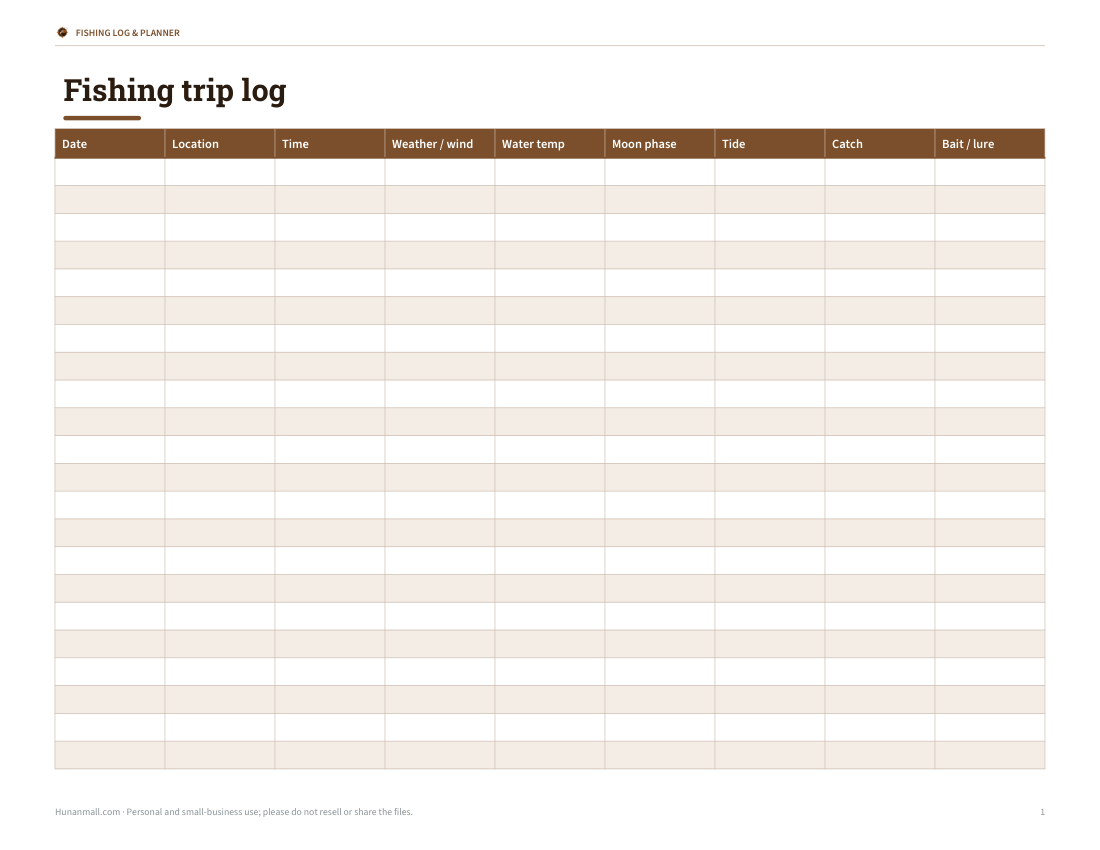
5 files · PDF, XLSX, DOCX
Fishing Log & Planner
Printable fishing planner: fishing trip log, catch record workbook (Excel) with species and conditions, a moon phase and solunar planning sheet, a tackle checklist and a knot reference card.
- Trip log (PDF/XLSX)
- Catch record (XLSX)
- Planning sheet (PDF)
- + 2 more
$5.00 USD, one-time 5 files · about $1.00 each
- Instant download
- 7-day refund
- Secure checkout by Stripe
7-day money-back guarantee. Full refund within 7 days of purchase, even after you download.
Free sample: Fishing Trip Log (PDF, 60 KB)
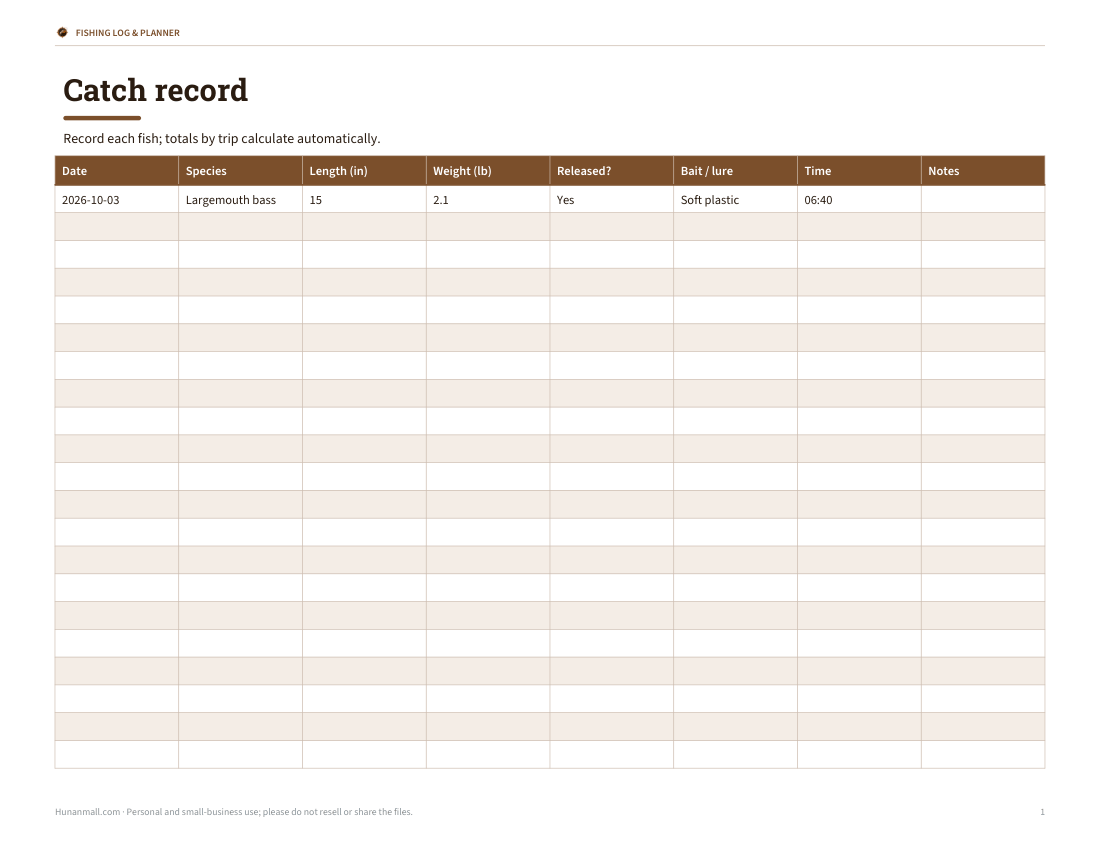
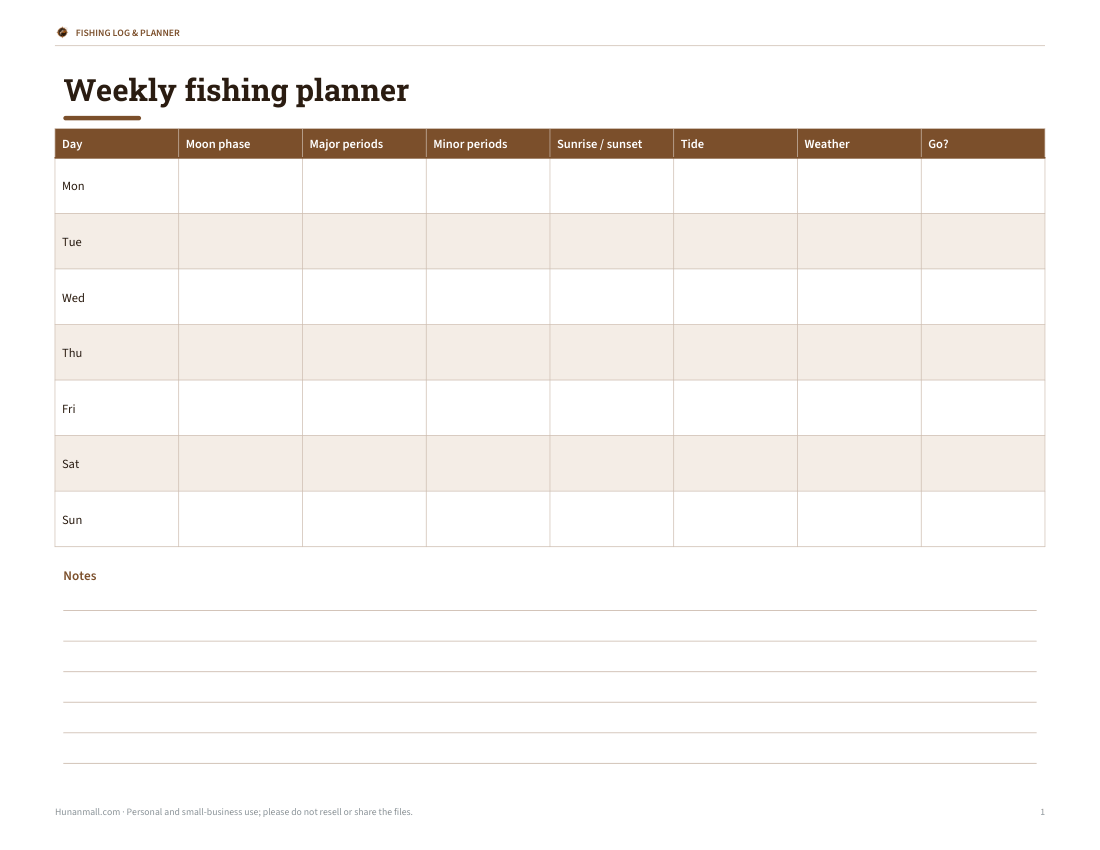
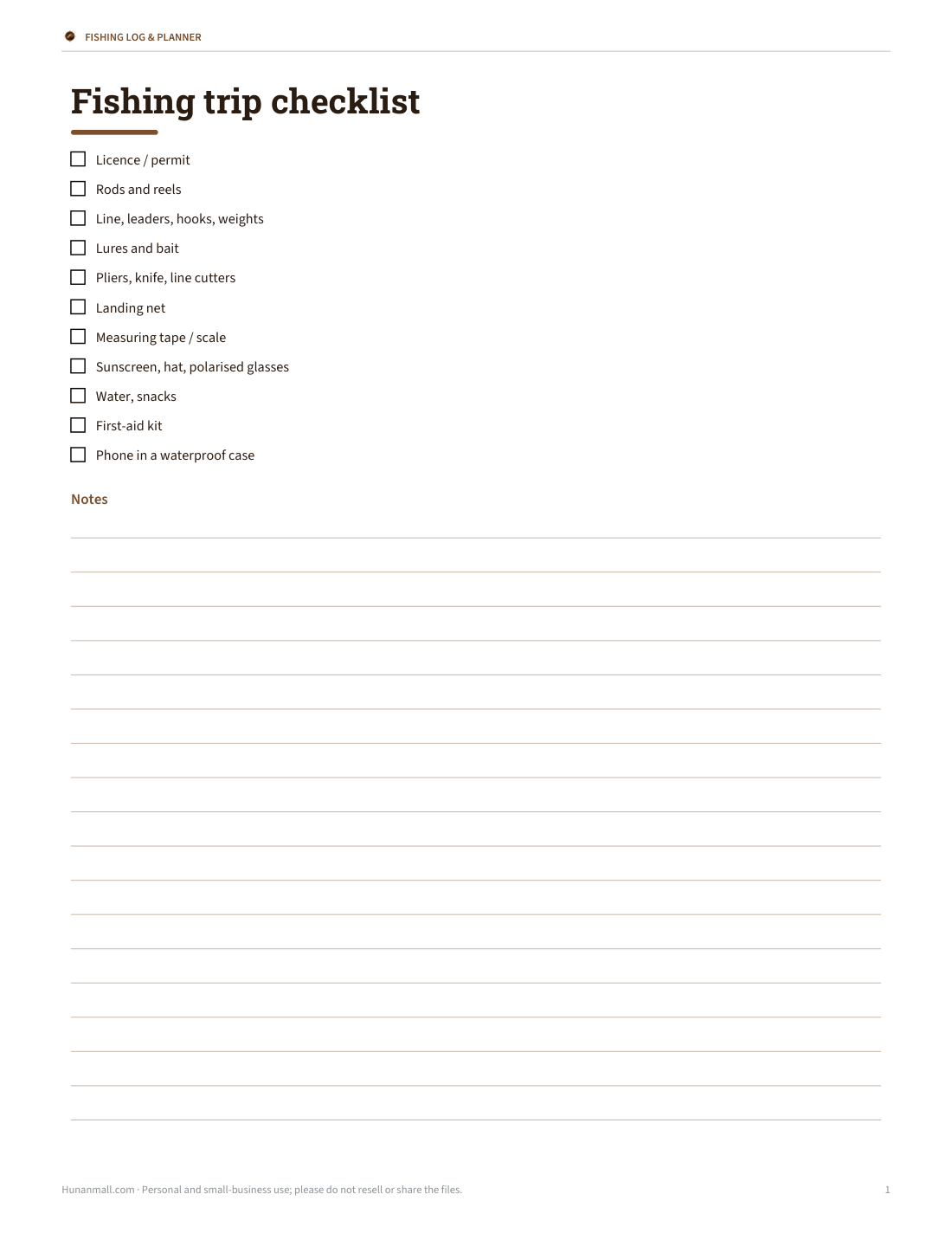
Fishing Log & Planner
Printable fishing planner: fishing trip log, catch record workbook (Excel) with species and conditions, a moon phase and solunar planning sheet, a tackle checklist and a knot reference card.
- Trip log (PDF/XLSX)
- Catch record (XLSX)
- Planning sheet (PDF)
- Tackle checklist (PDF, DOCX)
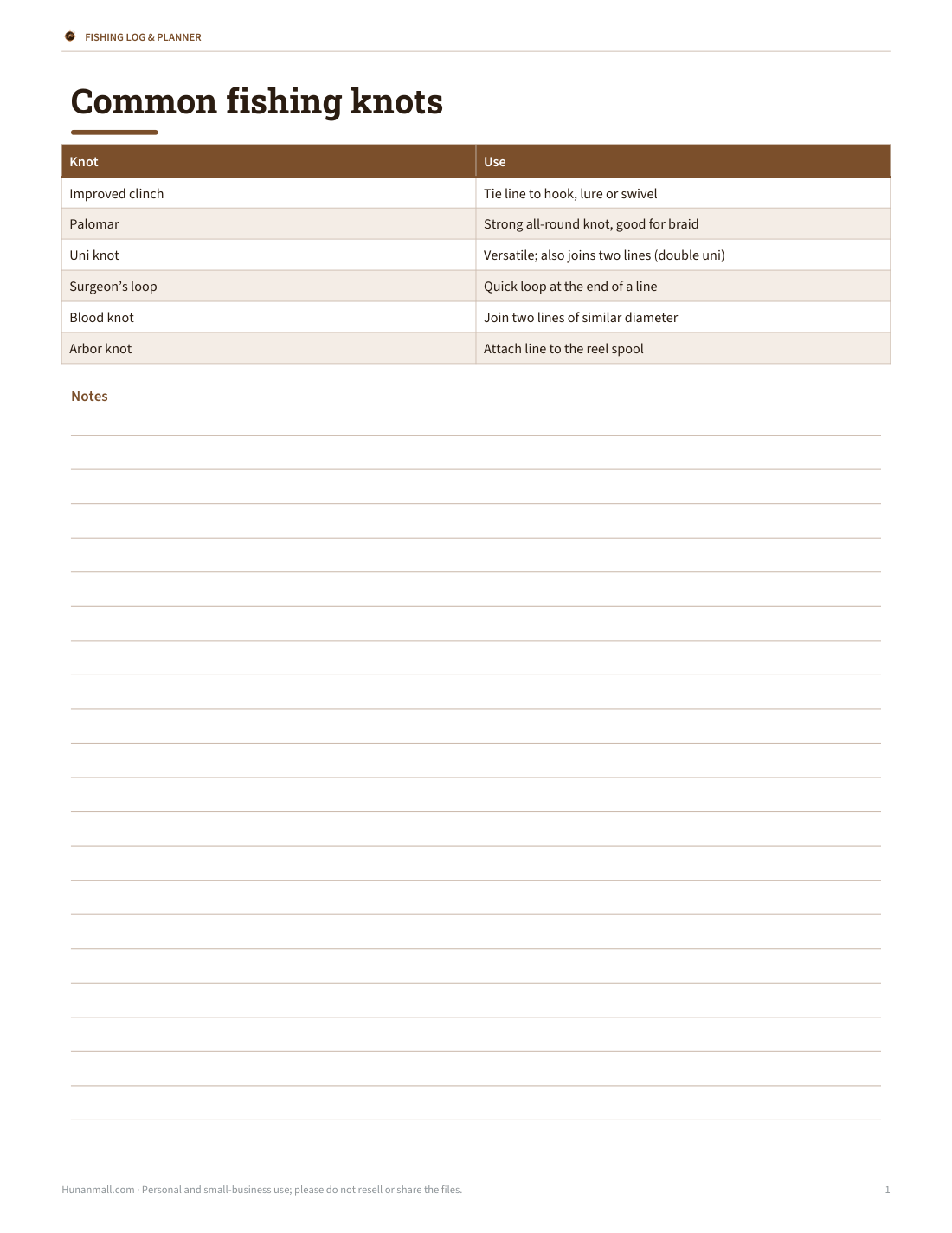
- Knot card (PDF)
Formats: PDF, XLSX, DOCX. Instant download after payment (link valid 72 hours, up to 5 downloads). AI-assisted: the templates were drafted with AI help and reviewed and laid out before publishing.
$5.00 USD, one-time 5 files · about $1.00 each
- Instant download
- 7-day refund
- Secure checkout by Stripe
7-day money-back guarantee. Full refund within 7 days of purchase, even after you download.
Free sample: Fishing Trip Log (PDF, 60 KB)
Full refund within 7 days — see the refund policy and license.
Free printables
Single sheets you can print right now, no sign-up. The full pack adds every sheet in one download plus the editable files.
 Printable Fishing Trip Log
 Printable Fishing Catch Record
 Printable Weekly Fishing Planner
 Printable Tackle Checklist
 Printable Fishing Knot Card
Fishing calendar
What solunar periods are
Solunar theory, popularised by John Alden Knight in the 1920s and 1930s, suggests that fish and game are more active at certain times linked to the Moon: major periods of about two hours centred on the Moon passing overhead (upper transit) and underfoot (lower transit), and minor periods of about an hour around moonrise and moonset. Days around the new and full moon are often rated highest. Many anglers use the tables as one planning factor among several.
What the evidence says
Scientific support for solunar tables is mixed. Tides, which are driven by the Moon and Sun, clearly affect fish in coastal waters, and light levels at dawn and dusk matter for many species. Studies of freshwater fishing success and the Moon have found small or inconsistent effects. Weather, water temperature, pressure changes, season, location and the angler’s skill usually matter more — so use the calendar as a guide, not a guarantee.
How the times are calculated
The calendar computes the positions of the Sun and Moon for your date and coordinates using astronomical formulas (JPL approximate orbital elements for the Sun and the main terms of Meeus’s lunar theory for the Moon), then finds when each rises, sets and crosses the meridian. Sunrise and sunset use the standard −0.83° altitude for refraction and the Sun’s disc; moonrise uses +0.13° to allow for the Moon’s parallax. Times are typically within a few minutes of published almanacs.
Reading the calendar
| Item | Meaning |
|---|---|
| Major period | 2 hours centred on the Moon overhead or underfoot |
| Minor period | 1 hour centred on moonrise or moonset |
| Day rating | Higher near new and full moon, plus a bonus when a solunar period overlaps sunrise or sunset |
| Moon phase | Phase and percentage of the disc lit |
| — (dash) | The event doesn’t happen on that calendar day — the Moon rises about 50 minutes later each day, so some days miss a rise or set |
How to use it
- Enter the date (today by default) and your fishing spot’s latitude and longitude, or tap “Use my location”.
- Check that the UTC offset matches local time, including daylight saving.
- Read today’s major and minor periods, the moon phase and sunrise/sunset.
- Scan the 7-day table to pick the best days for a trip.
- Combine the calendar with tides, weather and water conditions.
Worked example
For New York (40.71°N, 74.01°W) on the day of the 8 April 2024 solar eclipse, the new moon was overhead at almost the same time as the Sun, around midday, with moonrise and sunrise both around 6:30 a.m. and moonset just after sunset. The calendar rates such a day highly: a new moon, with minor periods overlapping dawn and dusk.
Fishing tips by time of day
- Dawn and dusk: low light encourages many predatory fish to feed in the shallows.
- Midday in summer: fish deeper, shaded water or structure.
- Overcast days: activity can spread through the day.
- Before a front: falling pressure often triggers feeding; after a front, fishing can be slow.
- Tides: in coastal water, moving tide (especially the first hours of the flood or ebb) usually beats slack water.
Privacy
Everything is calculated in your browser. If you use “Use my location”, your coordinates are used only on this page and are not sent anywhere.
Frequently asked questions
What is a solunar table?
A timetable of predicted fish and game activity based on the Moon’s position — major and minor periods.
What is a major period in fishing?
About two hours centred on when the Moon is directly overhead or underfoot.
What is a minor period?
About an hour around moonrise or moonset.
Is a full moon good for fishing?
Solunar tables rate new and full moons highly; results vary by species and water.
Are solunar tables accurate?
The astronomical times are accurate; the effect on fish is debated, so use them as one factor.
Is my location stored?
No, it is used only in your browser.